One of the United Nations (UN) Sustainable Development Goals (SDGs) set in 2015 includes Goal 8, which aimed to “promote sustained, inclusive and sustainable economic growth, full and productive employment and decent work for all” (United Nations). The Green Economy, social protection and sustainable tourism are the key areas of focus that fall under Goal 8. Sustainable tourism is a strategic framework that guides all tourism industry stakeholders in fostering long-term economic growth while safeguarding the environment and supporting local communities in tourist destinations.
The UN World Tourism Organisation defines sustainable tourism as:
“Tourism that takes full account of its current and future economic, social and environmental impacts, addressing the needs of visitors, the industry, the environment and host communities”
Sustainable tourism is held up by three pillars:
1. Environmental Sustainability:
Promoting and preserving the environment of tourist destinations. This includes biodiversity conservation, pollution and carbon footprint reduction and the protection of natural resources.
2. Socio-cultural Sustainability:
Promoting and preserving the cultures, traditions, and heritage of host communities and ensuring tourism directly benefits these communities as opposed to negatively impacting host environments and their communities. This includes respecting local practices and customs and practising ethical tourism (UNWTO).
3. Economic Sustainability:
Promoting and preserving the economic growth of the tourism industry at various scales. This includes promoting fair employment practices and supporting local businesses and community-led tourism providers. This is to ensure that host communities directly benefit from tourism by redirecting the flow of money to local economies over international corporations (known as economic leakage).
Our Role in Sustainability Tourism and Reflections
As travellers, sustainable tourism means we should aspire to make ethical travel decisions that are mindful of the environment, biodiversity and local communities.
Since learning about these principles, I started a journey of learning what this looks like when I apply them to my travel plans in a more practical and functional sense. It quickly became a broadening and yet overwhelming experience that I am still learning from, and so, with eaTravel, we will begin this process again.
Learning is admitting that there is space to be filled. I hope to fill it with verified insights while recognising that this space isn’t a vacuum and that it initially didn’t come empty either. I grew up, much like you, in a generation that was introduced to sustainability as the concept and its principles were still being shaped. Because even after all these years, sustainability, as a discipline and practice, is still in its developmental stage, and we have a ways to go before we establish global standard operating processes, monitoring and reporting.
I’m a geographer with a master’s degree in tourism sustainability and climate studies, focusing on niche tourism sectors. This lies at the heart of eaTravel, because travel, people and sustainable tourism are my passions. I have so much more to learn about sustainable tourism. In these conversations, I’ll also speak more about some of the things I need to unlearn and relearn about travelling (and moving into travelling more mindfully). We’ll also explore all the “moving parts” that shape this framework and some of our thoughts about eco-friendly, sustainable travel – and living.
EaTravel Pillar Three: Sustainability
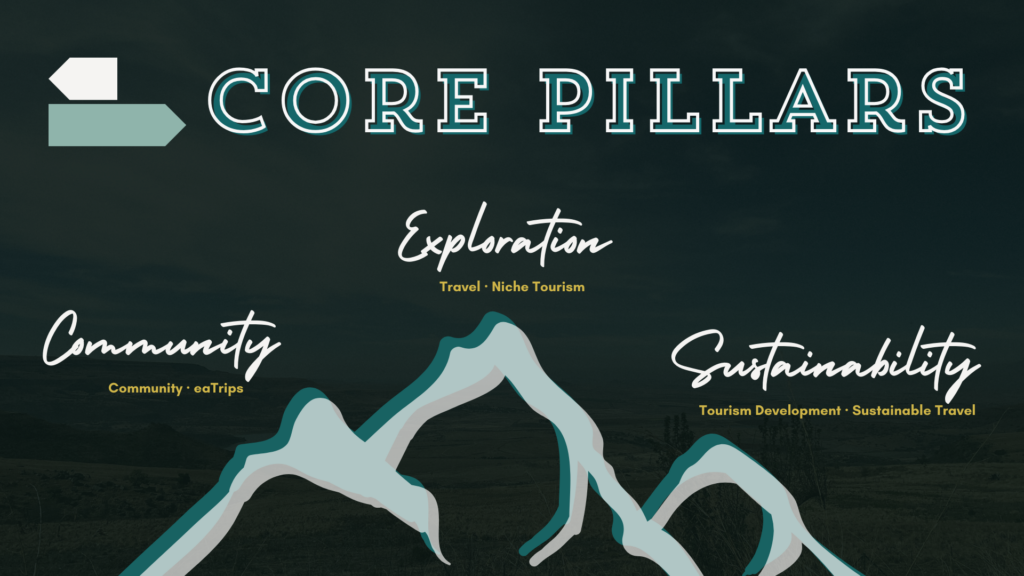
Sustainability: eaTravel’s third core pillar. Here, we’ll look at some of the events happening in the space or tourism development and moving towards sustainability in the industry, and most importantly, we’ll look at what sustainability means to us as a tourism community: in theory and in practice. Looking forward to it!
Thank you for being here!
Exploring, always,
Maz